

Duskbridge / Group strategy / Vertical integration / Operator notes
Owning the layer beneath you does not mean doing everything yourself
Owning the layer beneath you does not mean building everything yourself. It means controlling the few inputs that set your margin and your roadmap. Here is why control, not cost, is the reason to own an input, what published research says ownership is for, how to sort your own inputs, and how one Duskbridge company applies the idea.
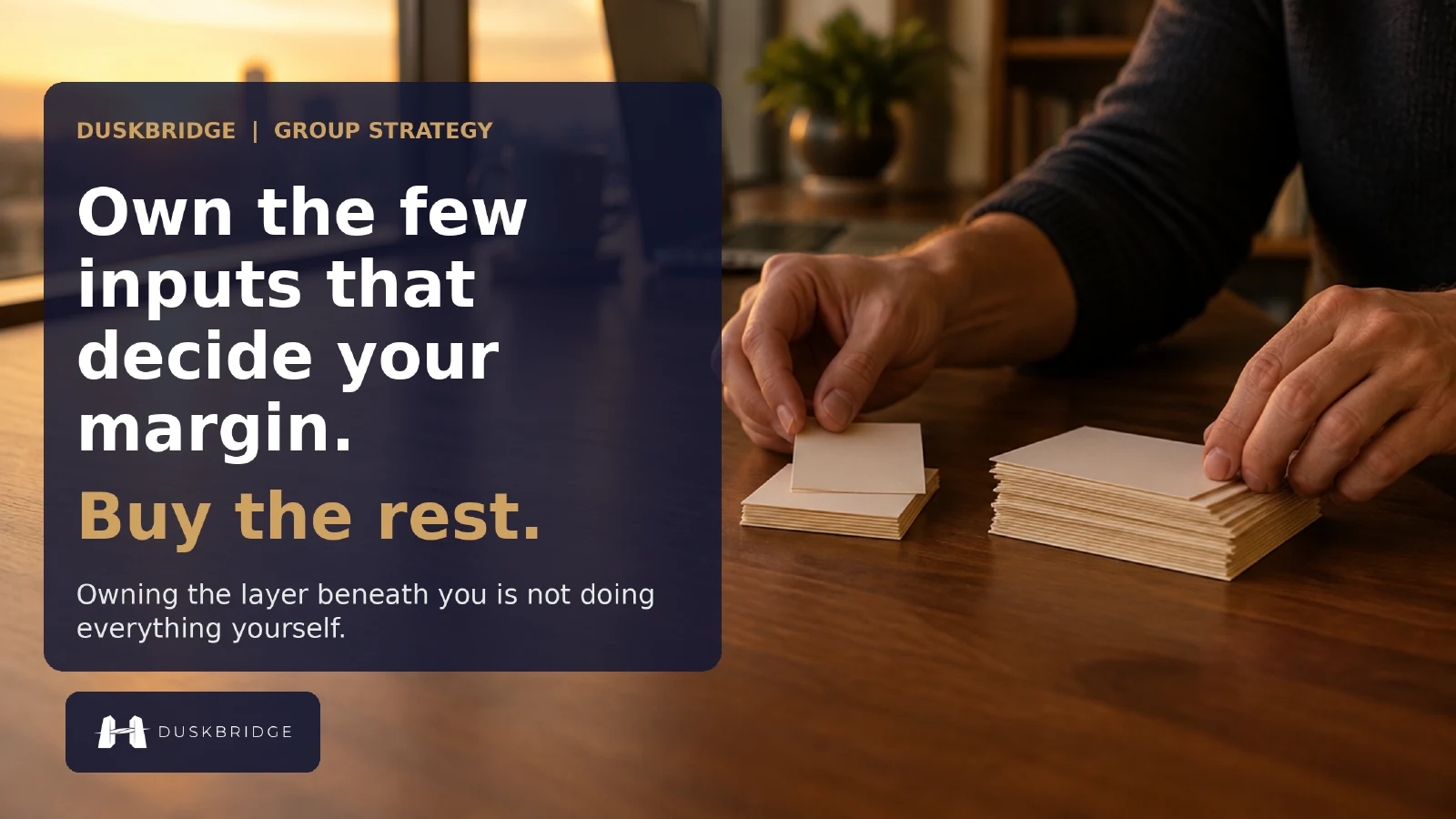
Own the few inputs that set your margin and your roadmap. Buy everything else. That is what owning the layer beneath you means, and it is a much smaller job than building everything yourself.
Margin is the money left after the cost of delivering what you sell. Roadmap is your plan for what you will build or offer next. If a supplier you cannot replace quickly controls either one, that supplier is part of your business whether or not their name is on your website. If a supplier you can replace in a few weeks controls neither, you have little reason to own what they provide.
This post covers why we think control, not cost, is the reason to own an input, what published research says ownership is actually used for, how to sort your own inputs, and how one Duskbridge company applies the idea.
Cost is the weak reason to own something
Vertical integration means owning more of the steps that make and deliver your product. It is usually sold as a cost story: remove the middleman and keep the middleman’s profit. In our view that argument is thin. A supplier’s price is often fair, and the savings are small next to what you take on when you build, staff, and repair the thing yourself.
The stronger reason is control over three things.
- Your pricing. If one supplier sets a large share of your cost, that supplier sets a large share of your price.
- Your roadmap. If your product depends on a supplier’s feature, their plans become your plans. A feature they retire is a feature you lose, on their schedule.
- What you can promise a customer. A buyer who asks about audit records, data handling, or delivery dates is asking about your supplier’s behavior as much as yours. You can only commit to what you control.
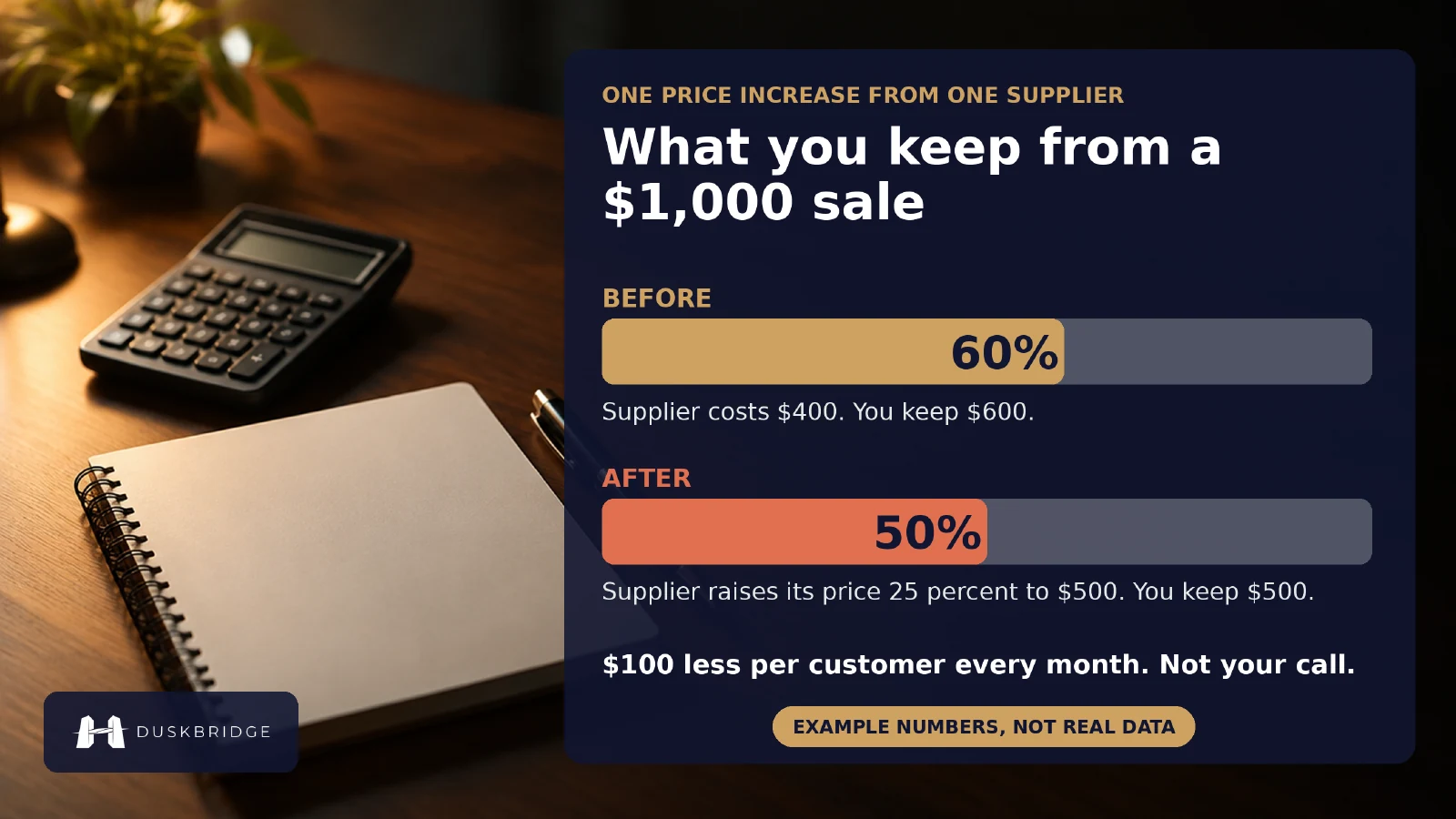
Worked example, using made-up numbers for illustration only and not Duskbridge data: a company sells a service for $1,000 a month per customer and pays one supplier $400 a month to deliver it. The company keeps $600, a 60 percent margin. The supplier raises its price by 25 percent, to $500. The company now keeps $500, a 50 percent margin. It can give up $100 per customer per month, or raise its own price and risk losing the customer. Neither choice was the company’s to make. If the company owned that one input, the supplier’s decision would not reach its margin.
What the research says ownership is for
The question of why companies own things instead of buying them goes back to Ronald Coase’s 1937 paper on why firms exist at all. Oliver Williamson applied it to vertical integration in the American Economic Review in May 1971. His paper starts from a puzzle: if using the market cost nothing, why would a company own a step in its own supply chain? His work looks at the cases where relying on the market falls short.
A later study points to where the value shows up. Enghin Atalay, Ali Hortacsu, and Chad Syverson studied goods-producing sectors and found that roughly half of upstream establishments report no shipments to downstream establishments in the same firm. In other words, ownership is not mainly used to move physical goods from one step to the next. The authors propose that it helps move intangible inputs, such as know-how, efficiently inside the firm. They also found that acquired establishments come to resemble their new parent along multiple dimensions.
Our reading: ownership pays where something hard to buy has to move, or has to stay under your control. It does not pay where a good can be bought at a fair price from three or more suppliers. That is the same line this post draws between two kinds of inputs.
Sort your inputs before you build anything
Run three questions on every input your product depends on.
- Who sets the price? If the answer is a single outside supplier, mark it.
- How long would it take to switch? A few weeks is manageable. A few quarters is a dependency.
- Does a promise to a customer depend on it? If you cannot commit to the customer without trusting someone else, mark it.
| Category | Decides your margin and roadmap | Does not |
|---|---|---|
| Typical signs | One supplier sets the price. Switching takes quarters. A customer promise rests on it. | Three or more suppliers offer the same thing. Switching takes weeks. No customer promise rests on it. |
| If someone else controls it | They can change your profit or delay your plans, and you have no say. | You can switch with little pain. |
| What to do | Own it, or secure real control over it. | Buy it and move on. |
Worked example 2, again using made-up numbers for illustration only: a software company lists five inputs and times how long each would take to replace.
| Input | Weeks to replace | Suppliers available | Customer promise rests on it | Decision |
|---|---|---|---|---|
| Payment processing | 4 | 5 or more | No | Buy |
| Email delivery | 2 | 5 or more | No | Buy |
| Office software | 1 | 5 or more | No | Buy |
| Approval and audit-record engine | 40 | 1 | Yes | Own |
| Customer data model | 36 | 1 | Yes | Own |
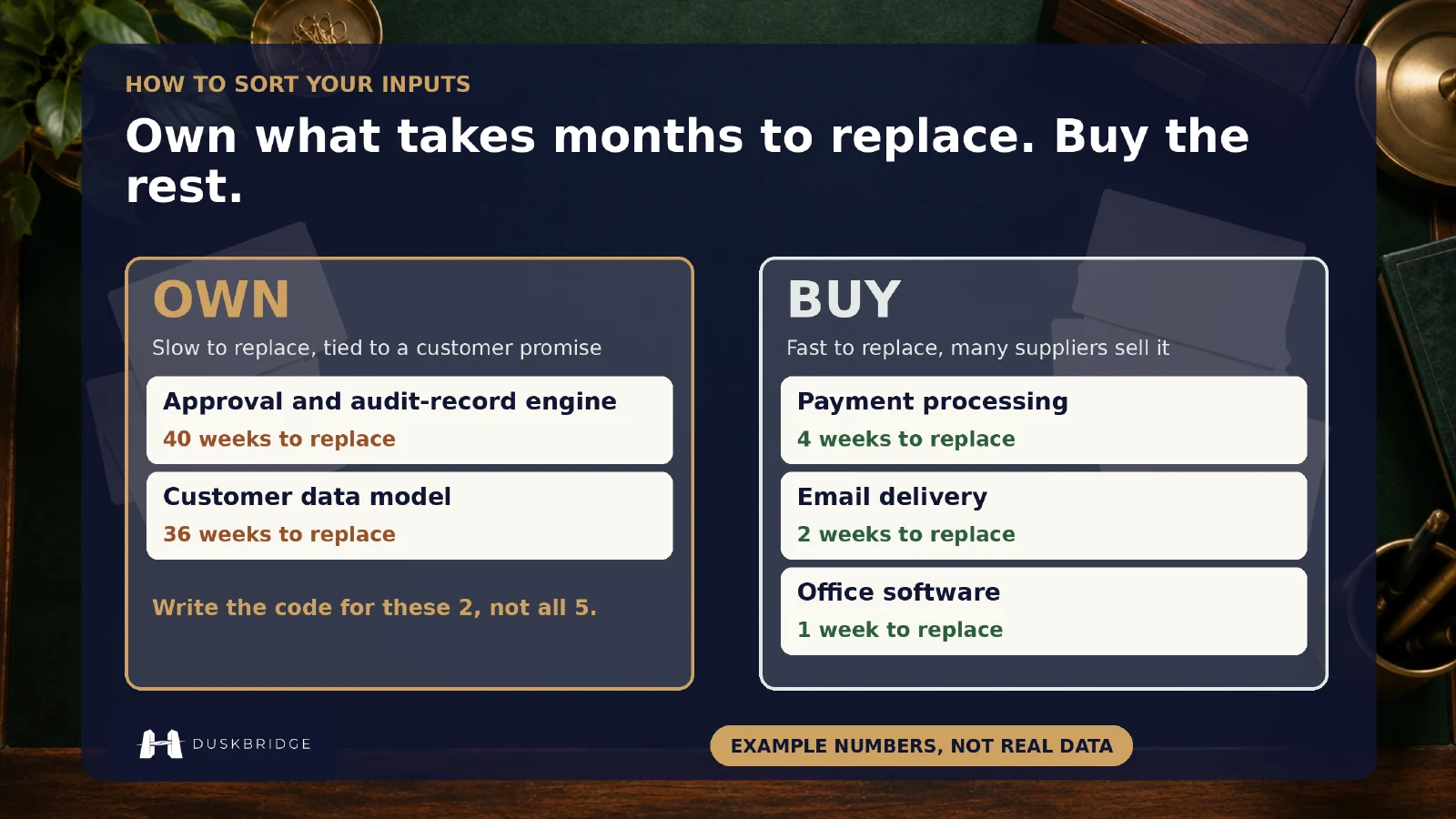
Three of the five inputs can be replaced in 4 weeks or less, so they stay outside the building. Two take about 8 to 9 months to replace and sit under a customer promise, so they are the ones worth owning. The company writes code for 2 inputs, not 5.
If two or three answers point to an outside supplier, that input belongs on your short list to own or control. If one does, write a clear contract and review it on a schedule. If none do, buy it.
When not to own something. If three or more good suppliers sell the same thing, ownership adds fixed cost and slows the team without adding control. Building it yourself in that case is cost without an edge.
A real example: Trunnion Core
Trunnion AI, a Duskbridge company, builds commercial AI software and organizes its platforms by industry instead of offering one product for everyone.
Underneath its products sits Trunnion Core. Trunnion describes Core as the orchestration runtime and developer platform for governed agentic software. Trunnion’s site lists Core with the status Live as of October 21, 2026. In plain words, Core is the shared base that coordinates AI agents, meaning software that takes actions and does not only write text. It connects the work an agent is asked to do with the authority it needs to do it. The Core page walks through a flow in which that authority is resolved before a consequential action goes ahead, and it describes routing work to a person for review where required.
Why this layer? Before a business lets software act for it, it asks 3 questions: what is the software allowed to do, who approved it, and is there a record afterward. Those answers decide what Trunnion can honestly promise a customer. If every product answered them its own way, each product would need its own rules, its own checks, and its own fixes. That is the kind of input that decides your roadmap, so it makes sense to own it once, in one place.
In our view, this is the pattern the post describes. When the questions that decide what you can promise are answered in one shared layer, you build them once and fix them once. Parts that do not carry those promises are easier to buy or build separately.
Two limits, stated plainly. Trunnion’s pages say product capabilities depend on the release, setup, and environment, and that product materials describe designed or configurable capabilities, not certifications. This post makes no certification claim.
The mistake and the fix
The mistake: treating ownership as a size contest. A company builds everything in house, spreads its team across a dozen projects, and still depends on one outside supplier for the single input that sets its price.
The fix: list your inputs. Mark the few that decide your margin and your plans. Put your effort there. Buy the rest. The 5-step test below takes an afternoon.
A second mistake is owning an input and never looking at it again. Control is only worth something while the input still decides your margin or roadmap. Put each owned input on a 90-day review. If three or more suppliers now sell the same thing at a fair price, consider buying it and moving the team to work only you can do.
Where Duskbridge fits
Duskbridge is the parent company of Viceroy NM and Trunnion AI. As we wrote on October 5, 2026, each company keeps 3 things of its own: its brand, its profit and loss, and its leadership. That structure follows from the idea in this post. A group does not need to merge its companies or build every part itself. It needs to be clear, company by company, about which few inputs decide margin and roadmap, and who controls them.
Trunnion Core is one answer for Trunnion AI. In a September 24, 2026 post, we gave a 1-sentence test for whether a group structure does real work: name one thing that moves between the operating companies that they would otherwise have to buy at market price. We apply the same discipline to ourselves.
Run the test this week
- Pick one product or service and write down everything it depends on.
- Cross out anything you could replace in a few weeks without harm.
- For each input left, write the name of the party that sets its price.
- Ask whether your plans would change if that input changed tomorrow.
- Where the price-setter is someone else and the answer to step 4 is yes, decide whether to own the input or secure control over it, and put a date on that decision.
Talk to us
If you are weighing which parts of your own product to build, buy, or lock in, contact Duskbridge. If you are evaluating Duskbridge as a partner or a candidate, ask us 2 questions about the operating companies discussed here: which inputs decide margin and roadmap, and who controls them.
This article presents Duskbridge’s view for general informational and educational purposes only. It is not legal, financial, medical, or other professional advice. Duskbridge makes no guarantee that it is accurate, complete, or current. Use of this information is at your own risk.
Details current as of October 21, 2026. Next review January 25, 2027. Group structure and product details can change, so confirm current terms with Duskbridge and Trunnion AI before relying on them.
Sources
Accessed October 21, 2026.
- Ronald H. Coase, The Nature of the Firm, Economica, vol. 4, issue 16, pp. 386-405 (November 1937).
- Oliver E. Williamson, The Vertical Integration of Production: Market Failure Considerations, American Economic Review, Papers and Proceedings, vol. 61, no. 2, pp. 112-123 (May 1971).
- Enghin Atalay, Ali Hortacsu, and Chad Syverson, Vertical Integration and Input Flows, American Economic Review, vol. 104, no. 4, pp. 1120-1148 (April 2014). See also the NBER working paper.
- Trunnion AI, Trunnion Core.
- Trunnion AI, Vertical vs. horizontal AI (October 16, 2026).
- Duskbridge, What a parent company does for its companies, and what it leaves to them (October 5, 2026).
- Duskbridge, How a better product loses a federal deal (September 24, 2026).
This article may discuss strategy, possible capabilities, acquisitions, investments, or market development. Those statements are forward-looking, uncertain, and not commitments or guarantees; see Terms section 6.
Continue the conversation