

Duskbridge / Federal procurement / Route to market / Group strategy
How a better product loses a federal deal
In federal procurement the product comparison happens last, after vehicle access, eligibility status and past performance have already removed most of the field. Here is the published data on how narrow that funnel is, what it means for a company selling into it, the test for whether a group structure actually helps, and how Duskbridge answers it.

The assumption underneath most go-to-market planning is that the buyer will compare options. In federal contracting, that assumption is wrong in a specific and expensive way.
By the time anything resembling a product comparison happens, the field has often already been cut by four filters that have little to do with product quality: which contract vehicle the requirement uses, whether the offeror’s size and eligibility status is correct, whether relevant past performance exists inside the solicitation’s usable window, and whether the proposed team appears in the offer.
A company that clears all four with an adequate product can beat a company that misses one with an excellent product. That is not a criticism of the system. It is the system, it is written down, and it is knowable in advance.
The buyer is shopping a list, not running a comparison
Start with the number that shapes everything else.
GAO reported in September 2025 that federal agencies spent more than $495 billion on common products and services in fiscal year 2024. Ten common spending categories accounted for more than half of federal contract spending. The same report said that less than 20 percent of common spending went through GSA, while category management had produced more than $111 billion in reported savings since 2014.
Put that next to the scale of the vehicles themselves. GSA’s fiscal year 2025 Annual Performance Report records Multiple Award Schedule sales of $52.53 billion against a $46.50 billion target. The same table reports $51.50 billion for fiscal year 2024.
Then put both against the total. GAO’s government-wide contracting snapshot reports about $755 billion in federal contract obligations for fiscal year 2024, down $22.5 billion from fiscal year 2023 after adjusting for inflation.
Two conclusions follow, and they point in different directions.
Being off the relevant vehicles closes a large door: tens of billions of dollars a year move through the Multiple Award Schedule alone. But being on that schedule does not open the whole building, because most common spending still does not go through GSA. There is no single list that gets a vendor in front of every buyer. There is a set of lists, each with its own award process and lead time. Being absent from the relevant one is not a loss to analyze afterward. It is an absence nobody records.
Four gates that close before the product is compared
| Gate | What it tests | Governing source | When it closes |
|---|---|---|---|
| Vehicle access | Whether the buyer can transact with the offeror through the route it selected | Agency acquisition strategy. GSA’s Multiple Award Schedule accepts offers continuously; many other contract vehicles use limited on-ramps | Often months or years before the requirement |
| Size and eligibility | Whether the offeror qualified under the solicitation’s NAICS size standard, including applicable affiliation rules | 13 CFR Part 121, including sections 121.103, 121.104, 121.106, and 121.404 | Commonly the date of the initial offer that includes price, subject to the rule and solicitation |
| Past performance | Whether the offeror has relevant and recent performance under the solicitation’s evaluation method | Solicitation terms. FAR 42.1503(g) directs agencies to use CPARS information within three years of completion, or six years for construction and architect-engineer work | The solicitation’s stated recency window |
| Teaming | Whether the capabilities and relationships being evaluated are disclosed in the offer | Solicitation terms. FAR Subpart 9.6 remains the codified text, while agency-specific FAR Overhaul deviations may use different Part 9 text | Offer submission for evaluation purposes |
The exact rule depends on the solicitation and the agency. That is the important qualification. The legacy FAR says contractor teams normally form before an offer but can form later, even after award. A later relationship can be valid for contract administration. It cannot retroactively place capabilities, people, or past performance into an offer that evaluators already scored.
CMMC shows why the route has to be monitored rather than memorized. The CMMC acquisition rule began a phased rollout on November 10, 2025. Phase 2 had been scheduled for November 10, 2026, with third-party Level 2 certification requirements in applicable solicitations. On July 13, 2026, the Department of War suspended Phase 2 and began a 60-day review. The department said Phase 1 self-assessments and the underlying obligation to protect covered defense information remained in place. The date moved. The underlying security obligation did not disappear.
A worked example: two vendors, one requirement
Two companies sell functionally comparable software to a federal program office with a requirement worth $4 million over three years.
Vendor A has the better product on every axis the end user cares about. It is not on the vehicle the agency uses for this category. It has no prior federal contract and therefore no CPARS record. Two weeks after the solicitation posts, it finds a partner that holds the vehicle, but the teaming agreement is signed after the partner’s offer goes in.
Vendor B has a product the end user rates lower. It has held a position on the relevant vehicle for four years. It completed a $600,000 contract with another agency fourteen months ago, and the CPARS record is satisfactory and current. Its specialist subcontractor was identified before the offer and described in it.
Vendor B wins, and not because the evaluators were wrong.
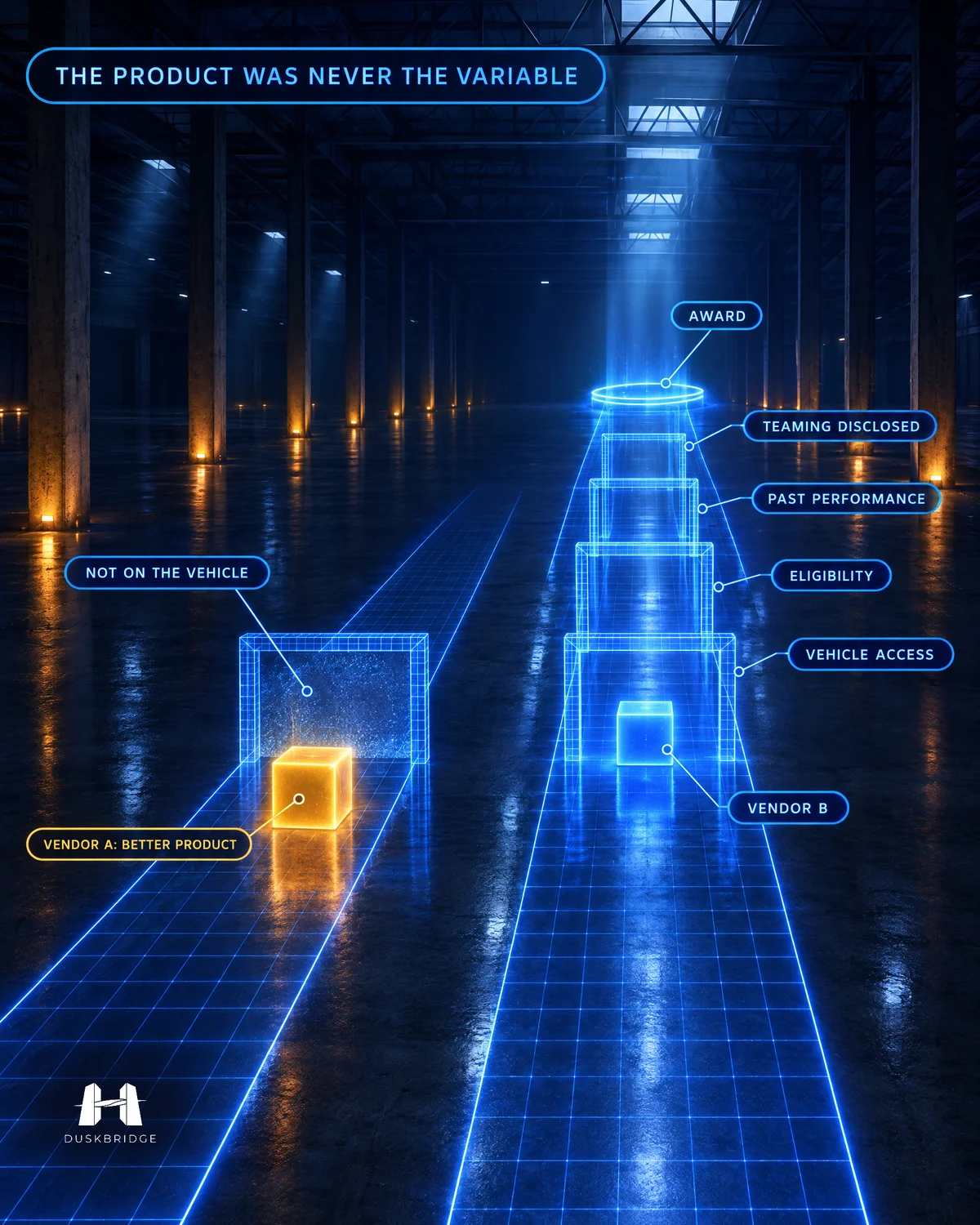
Vendor A cannot submit a prime offer under a vehicle competition that is limited to vehicle holders. Its remaining path is through an eligible prime. Because that prime’s offer went in before Vendor A joined the team, Vendor A’s product, people, and record are not in the proposal the evaluators received.
Even in an open negotiated competition where Vendor A could bid directly, FAR 15.305(a)(2)(iv) says an offeror without relevant past performance may not be evaluated favorably or unfavorably on that factor. Neutral is not a penalty, but it is not the positive discriminator Vendor B carries.
Vendor A may read this as a close loss and go improve the product. The product was never the variable.
This is not a federal quirk. It is what a channel is
The federal version is unusually legible because the rules are published. The commercial version has the same shape with less documentation.
Canalys estimated in 2025 that worldwide IT spending would reach $5.3 trillion and that just over 70 percent would be delivered through partners. Its channel research also projected managed services delivered through the channel at $595 billion in 2025.
Product quality determines whether a buyer is glad afterward. The channel determines whether the buyer was ever offered the product.
What it costs not to own the route
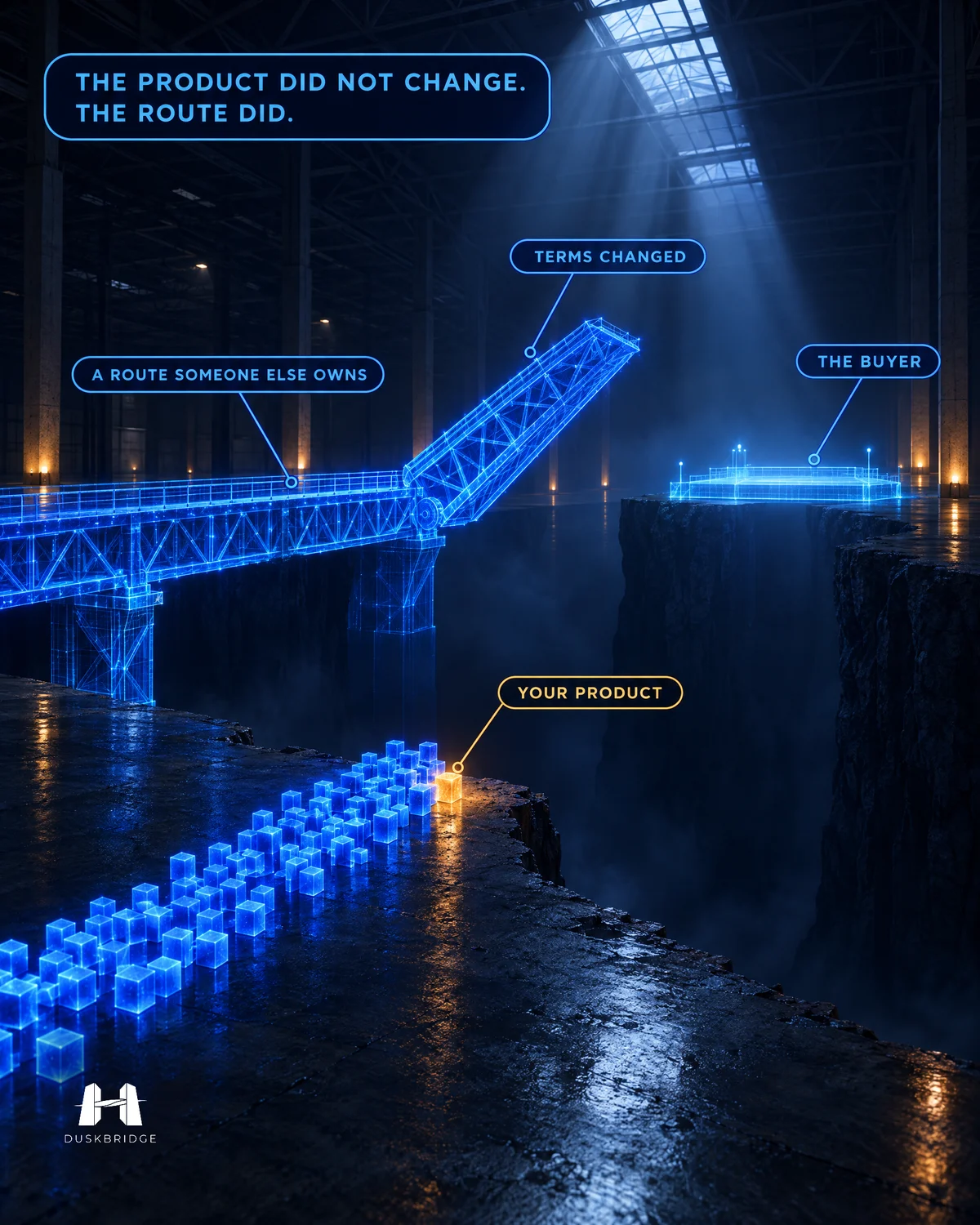
Two documented cases make the exposure concrete. One is an open competition complaint. The other is a completed platform dependency recorded in public filings.
VMware service providers after the Broadcom acquisition
Broadcom completed its acquisition of VMware on November 22, 2023. It later shifted major VMware offerings away from perpetual licensing and toward subscriptions, a change documented in Broadcom’s own end-of-availability guidance.
On March 19, 2026, CISPE filed a competition complaint with the European Commission. CISPE alleged that Broadcom had signaled the termination of the VMware Cloud Service Provider program in Europe, ended a white-label route used by smaller providers, and imposed pricing, bundling, payment, and commitment changes that raised some providers’ costs by more than 1,000 percent.
Those are allegations in an open complaint, not regulatory findings. What is not disputed is the structure: service providers built part of their businesses on a route controlled by another company, and that route’s commercial terms changed.
Zynga’s dependence on Facebook
Zynga’s 2012 Form 10-K disclosed that 86 percent of its revenue and 81 percent of its bookings came from games played on Facebook. The filing also described how a November 2012 agreement moved Zynga’s own game pages under Facebook’s standard terms beginning March 31, 2013, limiting Zynga’s ability to use Facebook data and communication channels to promote off-Facebook games. It further disclosed that Facebook changed its standard terms in December 2012 to restrict apps on the Facebook canvas from promoting games hosted elsewhere.
The product did not become worse. The route changed.
The honest version of the vertical integration argument
The intellectual foundation is old and well established. Ronald Coase framed the transaction-cost explanation for why firms exist rather than buying everything at market in The Nature of the Firm in 1937. Oliver Williamson applied that logic to vertical integration in 1971. Francine Lafontaine and Margaret Slade later surveyed the empirical evidence.
Silke Januszewski Forbes and Mara Lederman found that airlines were more likely to use owned regional carriers on routes where adverse weather made adaptation decisions more frequent. Their 2009 American Economic Review study is a clean example of integration paying off when real-time coordination is costly to renegotiate.
Then there is the finding that disciplines the lazy version of this argument.
Enghin Atalay, Ali Hortacsu, and Chad Syverson found that roughly one-half of upstream establishments reported no shipments to downstream establishments within the same firm. Their 2014 American Economic Review paper argues that vertical ownership can instead promote the transfer of intangible inputs such as processes, management practice, and know-how.
That finding does not break the integration argument. It sharpens it. If a group’s only justification is that one company sells another company’s product at a discount, the evidence says that is usually not where the value is. If the justification is an intangible that genuinely moves, the evidence says that is exactly where to look. The burden is to name the intangible.
The test, in one sentence
Name one thing that moves between the operating companies that they would otherwise have to buy at market price.
If nothing moves, the structure is a portfolio. That can be a legitimate structure. It is simply a different claim, and it should be described that way.
Where Duskbridge fits
Duskbridge is the parent company of Viceroy NM and Trunnion AI, and the group is built around the test above.
Viceroy NM is the group’s federal contracting company. It holds the registrations and small-business status used for its federal work, along with a record of fulfilled federal contracts across multiple agencies. That record is currently rooted in product fulfillment. Software past performance is a separate gate, so it has to be planned into the roadmap before a solicitation arrives.
Trunnion AI builds governed enterprise AI software in which authority, review, and operating context are part of the product design. Exact capabilities, controls, standards alignment, and evidence vary by product release and deployment and should be confirmed at the operating-company source.
Duskbridge owns both companies and sets the roadmap across them. For federal work involving Trunnion AI software, Viceroy NM owns the contracting route.
Our answer to the test is the route. Without Viceroy NM, Trunnion AI would have to reach federal buyers through a prime or reseller on that partner’s terms, or build a federal registration and performance record from zero. Inside the group, the route is planned alongside the product rather than after it.
That answer is intended to be checkable. Federal registrations and award history can be researched through SAM.gov and USAspending.gov. Ask the same question of any group structure and see whether the answer names a real operating input or only a slide.
The mistake and the fix
The mistake: treating route to market as a sales problem to solve after the product is ready. By then, the lead times may already have run out. A vehicle position, a useful performance record, and a required assessment can each take longer to establish than a sales cycle takes to close.
The fix: treat the route as part of the product roadmap, with milestones, evidence, and an owner.
- Which route will the buyer use? If the company is not on it, that is a separate project with its own timeline, not merely a bid task.
- What will the performance record look like in three years? CPARS information has a limited source-selection window, and the clock runs whether anyone is watching it or not.
- Who controls a route the company depends on? If the answer is a platform or a partner, the VMware and Zynga cases show how the exposure can land.
- What moves between the entities that would otherwise be bought at market? If the honest answer is nothing, the group structure is not doing operating work and should not be the center of the story.
The better product still matters. It just is not always the first thing the buyer checks. Building as though it were is how good companies lose deals they never appeared in.
Talk to us
Federal buyers, prime contractors, and technology companies can discuss capability, registration, and teaming questions with Viceroy NM. Start that conversation before the solicitation posts, not after. That is the argument of this article.
If you are evaluating Duskbridge as an investor, operator, or strategic partner, contact Duskbridge and ask us the test question.
Published September 24, 2026. Procurement rules and solicitation terms change. Readers should confirm the current regulation, agency deviation, solicitation, and contract language before acting.
This article may discuss strategy, possible capabilities, acquisitions, investments, or market development. Those statements are forward-looking, uncertain, and not commitments or guarantees; see Terms section 6.
Continue the conversation