

Duskbridge / Group strategy / Prioritization / Operator notes
How a small group decides what not to build
Write the no before the yes. Five questions help a small group choose what not to build, protect limited working time, and keep good ideas from becoming half-built projects.
Decide what not to build by writing the no down before you write the yes. A small group has a fixed amount of working time each quarter, so every project it starts is a project it has chosen not to start. Test each idea with five questions, and send any idea that fails to a not-now list with a reason and a review date, instead of letting it sit half-built. The five questions are our opinion, not a published standard, but each one answers a problem that research on project portfolios keeps finding.
A note on what this is. This post is Duskbridge’s opinion. The research below is cited and attributed to its authors. The five questions, the reserve, the review dates, and the examples are our own judgment. They are not a Duskbridge policy, a published standard, or advice.
A small team usually has more good ideas than it has time to finish. Having the ideas is rarely the hard part. The hard part is saying no to a good one, out loud, in a way that holds. By a small group, we mean a handful of people choosing among projects with limited time, whether that is a team of six or a parent company choosing among several projects.
This post covers why researchers treat “no” as the main work of strategy, why stopping a project is harder than never starting it, the five questions, a worked example with illustrative numbers, and the mistakes that turn a not-now list back into a wish list.
Why the answer is mostly no
Michael Porter made the case in the Harvard Business Review in 1996. A strategy, he argued, is mostly a set of trade-offs: choosing one position means giving up others, which is why strategy comes down to deciding which activities to leave out.
The cost of ignoring that shows up in product development research. Robert Cooper, who writes on managing new-product portfolios, describes what he calls pipeline gridlock: more projects in progress than the available people can support. In his 2021 article, the effects are that people are spread too thin, every project is under-resourced, projects take longer to reach the market, and teams skip steps such as customer research.
A separate paper reaches the same place. F. Larsson presented a paper in 2006 at the Design 2006 conference in Dubrovnik, based on interviews with senior staff at six manufacturers in Denmark and the United States. It argues that a company that takes on more projects than its people can support loses productivity, and that the pressure to cut corners shows up later as quality problems. The author states that the sample is small and not representative of industry in general, but the pattern matches Cooper’s.
In our view, the point for a small group is simple. You do not have a spare team to absorb the extra project. When you add one, you thin out all the others.
Why stopping is harder than not starting
Once time or money is spent, it feels wrong to walk away. Psychologists call money or effort that cannot be recovered a sunk cost, and they have measured how much it pulls on decisions.
In a well-known 1985 study, Hal Arkes and Catherine Blumer sold season tickets to a university theater at one of three prices: the full $15, $2 off, or $7 off. People who paid the full $15 attended more of the plays in the first half of the season, about six months, than people who paid less for the same season of plays. The difference faded in the second half. The money was already gone either way, yet it changed behavior.
A 1976 study by Barry Staw found the same pattern inside a business setting. Business students played the role of an executive dividing research money between two divisions. Those who had made the earlier funding choice themselves, and then saw it go badly, put the most additional money into that same choice.
Cooper’s 2021 article adds how this plays out in companies. Projects approved on a strong early case keep moving as their value declines, and the gates meant to stop them turn into milestone checks where the option to kill a project is rarely used. Larsson’s paper points the same direction: without explicit criteria for choosing and stopping projects, it is hard to reject a proposal or end a project already underway, so the pipeline fills.
Our reading is that the time to decide what would make you stop is before you start, while you are still neutral.
The five questions
Ask all five of every idea. This is our own method, built from the problems above. It is our opinion about how to work, not a standard from any outside body and not a Duskbridge policy.
| Question | Passes when | Fails when |
|---|---|---|
| 1. Who is the one buyer, and have they asked for this? | A named kind of buyer asked, in their own words | "Buyers would probably like it" |
| 2. Does it use something we own, or something we would rent? | Whatever it depends on that matters, we control | A critical input depends on a supplier who can change the terms |
| 3. What do we stop doing to make room? | A named project or task gets less time | "We will fit it in" |
| 4. Can the people we have finish a first version this quarter, with no one counted twice? | The weeks add up to less than the weeks we have | It needs someone who is already full |
| 5. What would make us stop, and who decides? | A written stop sign, a named person, and a date | "We will see how it goes" |
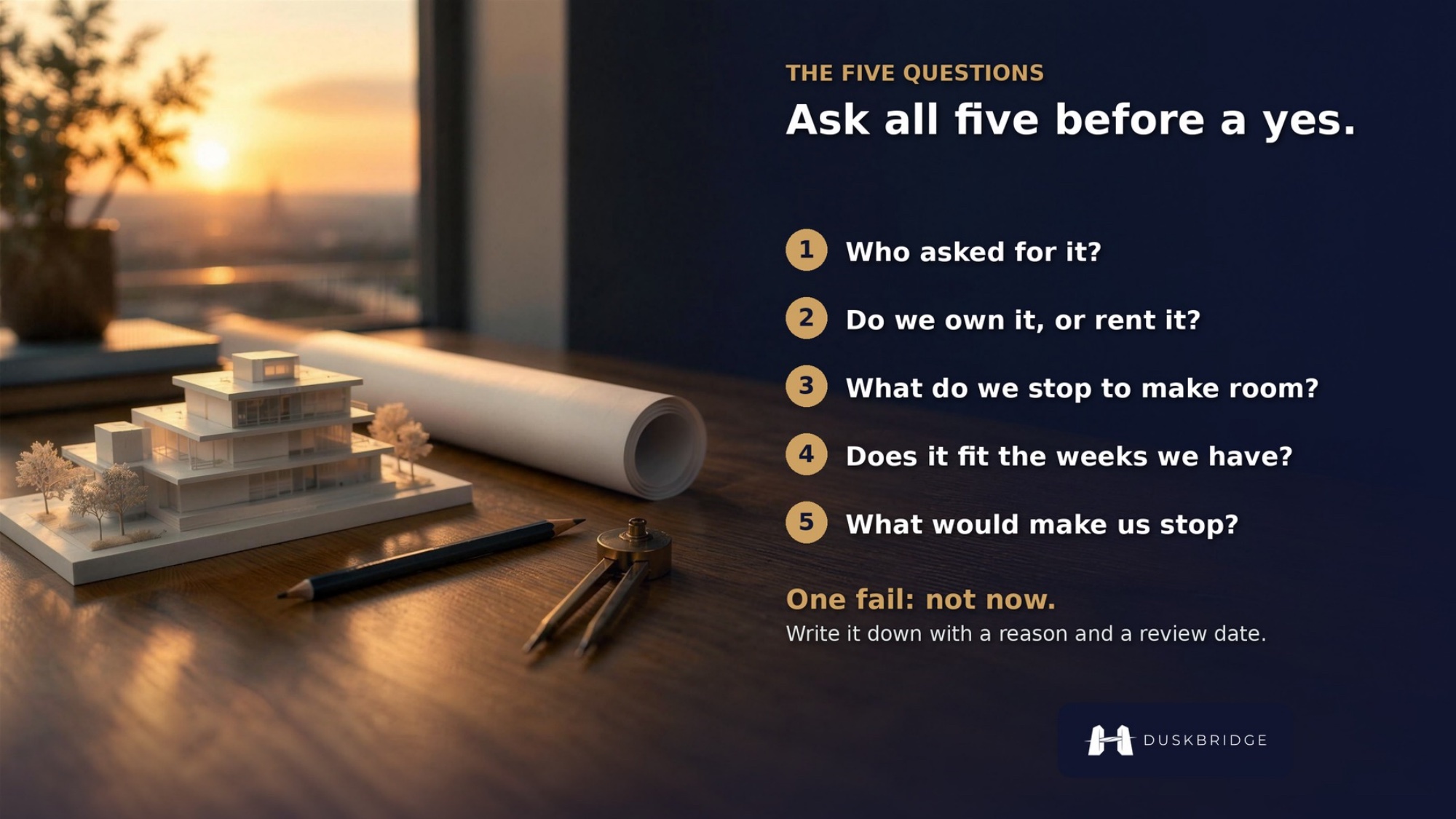
Our rule: one fail means not now. The idea goes on a written list, and it does not get a quiet half-start.
Question 2 comes from our earlier post on owning the layer beneath you. That post makes the longer case for why renting an input you depend on puts your margin and your roadmap in someone else’s hands, and it is just as clear that you do not need to own everything. This question is about the inputs your margin and roadmap rest on, not every tool you use. Question 5 is the easiest one to skip, and the research above is the reason it is on the list.
Worked example: five ideas, one quarter
Illustrative numbers, not Duskbridge data. A small software group has 3 builders and a 12-week quarter. That is 36 builder-weeks of capacity (3 x 12). It has five ideas. The table scores each one against questions 1, 2, and 4. A “week” below means one builder working for one week.
| Idea | Builder-weeks | Buyer asked? | Uses what we own? | Fits what is left? | Decision |
|---|---|---|---|---|---|
| A. Self-service invoice portal | 18 | Yes | Yes | Yes, 18 of 36 used | Build |
| B. Monthly report export | 12 | Yes | Yes | Yes, 30 of 36 used | Build |
| C. Mobile version | 10 | Yes | Yes | No, needs 10 with 6 left | Not now |
| D. Resell a partner's analytics tool | 8 | Yes | No, it rents | No, needs 8 with 6 left | Not now |
| E. Customer community site | 24 | No | Yes | No, needs 24 with 6 left | Not now |
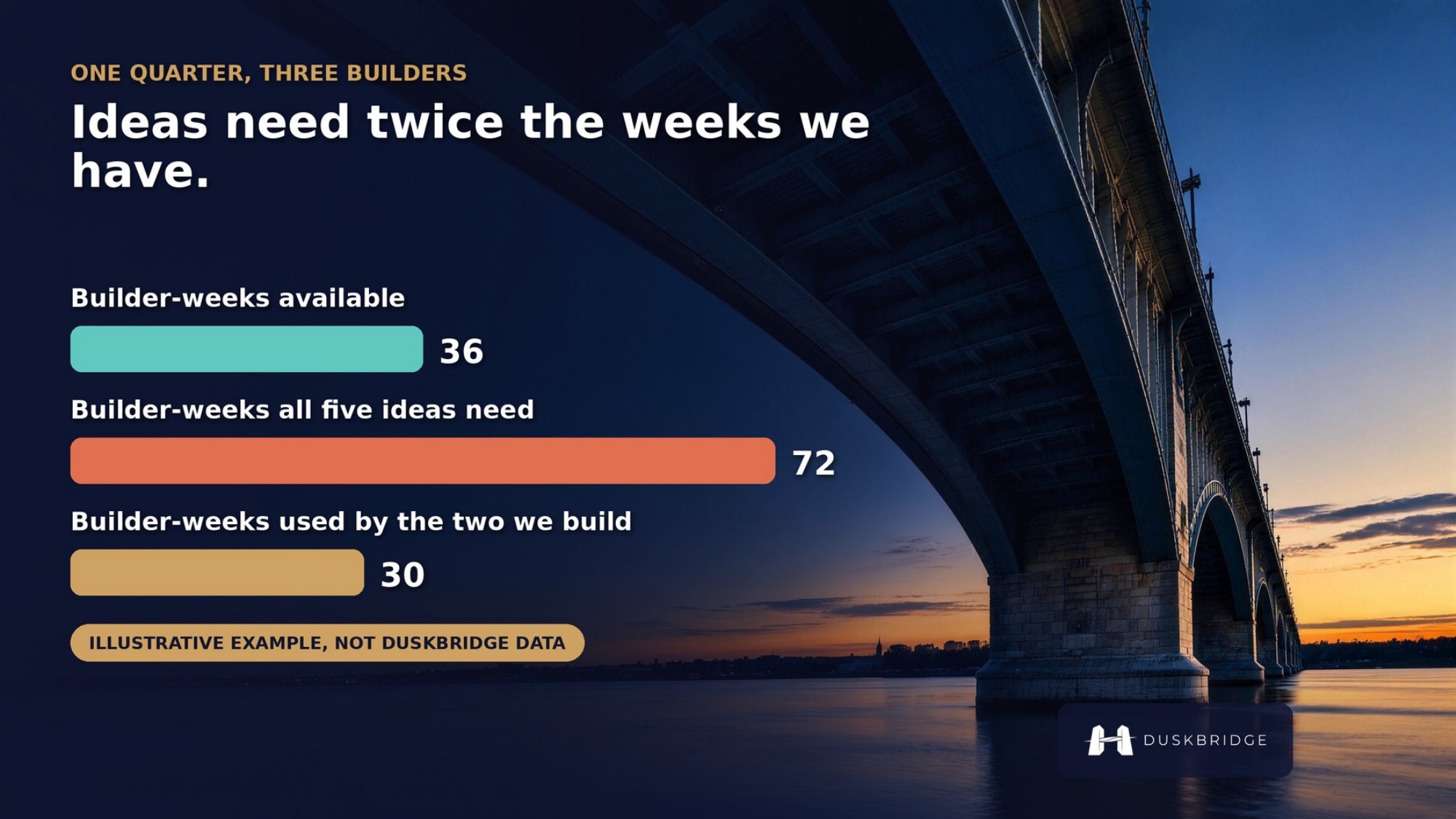
All five ideas together need 72 builder-weeks (18 + 12 + 10 + 8 + 24), which is twice the 36 available. If the group said yes to everything, each project would get on average half the time it needs. That is the gridlock Cooper describes, in a group small enough to count on one hand.
Instead, the group builds A and B, which use 30 of the 36 weeks. The remaining 6 weeks, about 17 percent, are held back for surprises. That reserve is our rule of thumb, and you should set your own. Ideas C, D, and E go on the not-now list, each with its reason. Idea D also fails question 2, because the whole product would run on a tool we rent.
What a written no looks like
A no only helps if it is written so that someone can find it, challenge it, and bring it back on purpose. Each entry needs five fields: the idea, the reason, what would change the answer, who owns the review, and the review date.
Example entry, for illustration only. Idea: customer community site (E). Reason: no buyer has asked for it, which fails question 1. What would change it: a buyer asking for it in their own words, and 24 free builder-weeks. Owner of the review: the product lead. Review date: 90 days out, which for a decision made on November 8 is February 6.
In our view, two things make this list different from a graveyard. Each entry says what would bring the idea back, so a new fact can reopen it. And each entry has a date, so a no is reviewed instead of forgotten.
Three mistakes and the fix
These are the three we think matter most, and the fixes are our suggestions.
Mistake 1: no stop sign before the start. A project begins with a yes and nothing else. By the time it is struggling, the people who chose it are the people judging it, which is the setting where Staw found the most additional money going in. The fix is question 5: write down what would make you stop, who decides, and when, before the first week is spent.
Mistake 2: a review that only reports. The group meets, hears that every project is on track, and approves them all again. Cooper describes gates that drift into milestone checks, where the option to kill a project is rarely used. The fix is to make every review answer one question: if we were starting today, would we start this? A yes keeps it. A no stops it, and the freed weeks go to the next idea on the list.
Mistake 3: small requests that eat the quarter. Cooper also describes small fixes and tweaks that use up the people the larger projects need. The fix is a fixed allowance. For example, the group in our worked example could cap small requests at 1 builder-day per week, about 12 days of the 180 builder-days in the quarter (3 builders x 60 working days), and treat anything beyond that like any other idea. The allowance is a choice the group makes, not a number from the research.
Where Duskbridge fits
Duskbridge is the parent company of Viceroy NM and Trunnion AI, the companies discussed here. As we described in our October 5, 2026 post, each company keeps its own brand, its own profit and loss, and its own leadership, and the group sets only a short list of shared standards. That arrangement shapes how this question works for us. In our view, a company that keeps its own leadership and its own books is best placed to decide what it builds.
This post is a method for any small group, not a description of any one product decision. The group-level piece is narrower: question 2, which asks whether an idea runs on something you own or something you rent. That is the same principle Duskbridge states in its public thesis about owning the layer beneath you.
Run this week
- List every idea your group is carrying, including the half-started ones.
- Estimate each idea in weeks of work, then write down the weeks your people actually have this quarter.
- Score each idea against the five questions, and mark every one with at least one fail.
- Write a not-now entry for each marked idea with a reason, what would change the answer, an owner, and a review date 90 days out.
- Hold back about one-sixth of your weeks for surprises, then build only what fits in the rest.
- For each project you keep, write its stop sign: what would make you stop, who decides, and when.
Talk to us
If you are working through a decision like this one, or want to compare notes on how a small group chooses, contact Duskbridge.
This article is for general informational and educational purposes only. It is not legal, financial, medical, or other professional advice. Duskbridge makes no guarantee that it is accurate, complete, or current. Use of this information is at your own risk.
Details current as of November 8, 2026. Next review February 6, 2027.
Sources
Sources accessed November 4 and November 8, 2026.
- Michael E. Porter, What Is Strategy?, Harvard Business Review, November-December 1996, pp. 61-78.
- Robert G. Cooper, Unlocking Pipeline Gridlock: Effective Portfolio Management Is the Key, InnovationManagement.se (November 8, 2021).
- F. Larsson, Declining Productivity in Product Development: An Explanation of Pipeline Gridlock, Design 2006 International Design Conference, Dubrovnik (2006).
- Hal R. Arkes and Catherine Blumer, The Psychology of Sunk Cost, Organizational Behavior and Human Decision Processes, vol. 35, pp. 124-140 (1985).
- Barry M. Staw, Knee-Deep in the Big Muddy: A Study of Escalating Commitment to a Chosen Course of Action, Organizational Behavior and Human Performance, vol. 16, pp. 27-44 (1976).
- Duskbridge, What a parent company does for its companies, and what it leaves to them (October 5, 2026).
- Duskbridge, Owning the layer beneath you does not mean doing everything yourself (October 27, 2026).
This article may discuss strategy, possible capabilities, acquisitions, investments, or market development. Those statements are forward-looking, uncertain, and not commitments or guarantees; see Terms section 6.