

Duskbridge / Group strategy / Brand architecture / Operator notes
Why each company in a group keeps its own brand
Same group. Two buyers. Two promises. A company should keep its own brand when its buyers need a different promise than a sibling company's buyers do. Here is the research, four practical tests, and what a separate brand costs.
A company in a group should keep its own brand when its buyers need a different promise than the sibling company’s buyers do. If both sets of buyers need the same promise, one brand is cheaper to run, and published research treats one brand as the better starting point. The companies discussed here, Viceroy NM and Trunnion AI, pass the first test, so each keeps its own brand.
A brand is the set of expectations a buyer carries into a purchase. This post covers what the research says about one brand versus separate brands, why a brand works as a promise to one buyer, four tests you can run on your own group, what a separate brand costs, and how Duskbridge applies it.
The research starts on the side of one brand
Start with the argument against splitting, because it is the stronger default. David Aaker and Erich Joachimsthaler, writing in California Management Review in 2000, describe a spectrum from one master brand to fully separate brands. They treat the single master brand as the default and say a separate brand should be built only when a compelling need can be shown. The conditions they list include owning a distinct benefit, avoiding an association that would hurt the brand, protecting a sales channel, and keeping the bond with customers of an acquired brand. They add that a business too small or short-lived to fund its own brand building should not try.
The financial evidence leans the same way. Vithala Rao, Manoj Agarwal, and Denise Dahlhoff studied 113 US firms using five years of data. They compared firms that branded under the corporate name, firms that branded each product separately, and firms that mixed both. Corporate branding was associated with higher Tobin’s q, the ratio of a firm’s market value to the replacement cost of its assets, which the authors use as a proxy for intangible value. Mixed branding was associated with lower Tobin’s q. Their earlier working paper for the Marketing Science Institute reported that separate-brand and mixed firms both scored below corporate-branded firms. The authors report an association, not a cause, and suggest firms could have raised that measure by choosing a different strategy.
Our reading: the burden of proof sits on the separate brand. A group that keeps two brands should be able to name the specific reason in the buyer’s terms, not in the organization chart’s terms.
A brand is a promise to one buyer
Two companies in one group can have two different buyers checking two different things, because a brand makes a promise that a particular buyer can check.
Duskbridge describes Viceroy NM as a government contracting company that does work for multiple federal agencies and national laboratories. It describes Trunnion AI as a company that builds commercial AI software and sells it as a subscription service. In our view, a federal reviewer reading a bid checks it against the stated criteria, and any gap is a reason to set it aside, so the promise has to be precise and checkable. A commercial technical buyer looking at software is looking for the architecture underneath the pitch, so the promise has to show the mechanism.
Worked example, using made-up numbers for illustration only and not Duskbridge data: write down the five questions each buyer asks before saying yes, then count how many are the same.
| Question a buyer asks | Federal reviewer | Commercial software buyer |
|---|---|---|
| Can you show a record of delivered work? | Yes, asked | Sometimes |
| Can you show how the product controls what it does? | No | Yes, asked |
| Is your compliance posture stated plainly? | Yes, asked | Sometimes |
| Can I try it myself before I commit? | No | Yes, asked |
| Is a named leader accountable for the result? | Yes, asked | Yes, asked |
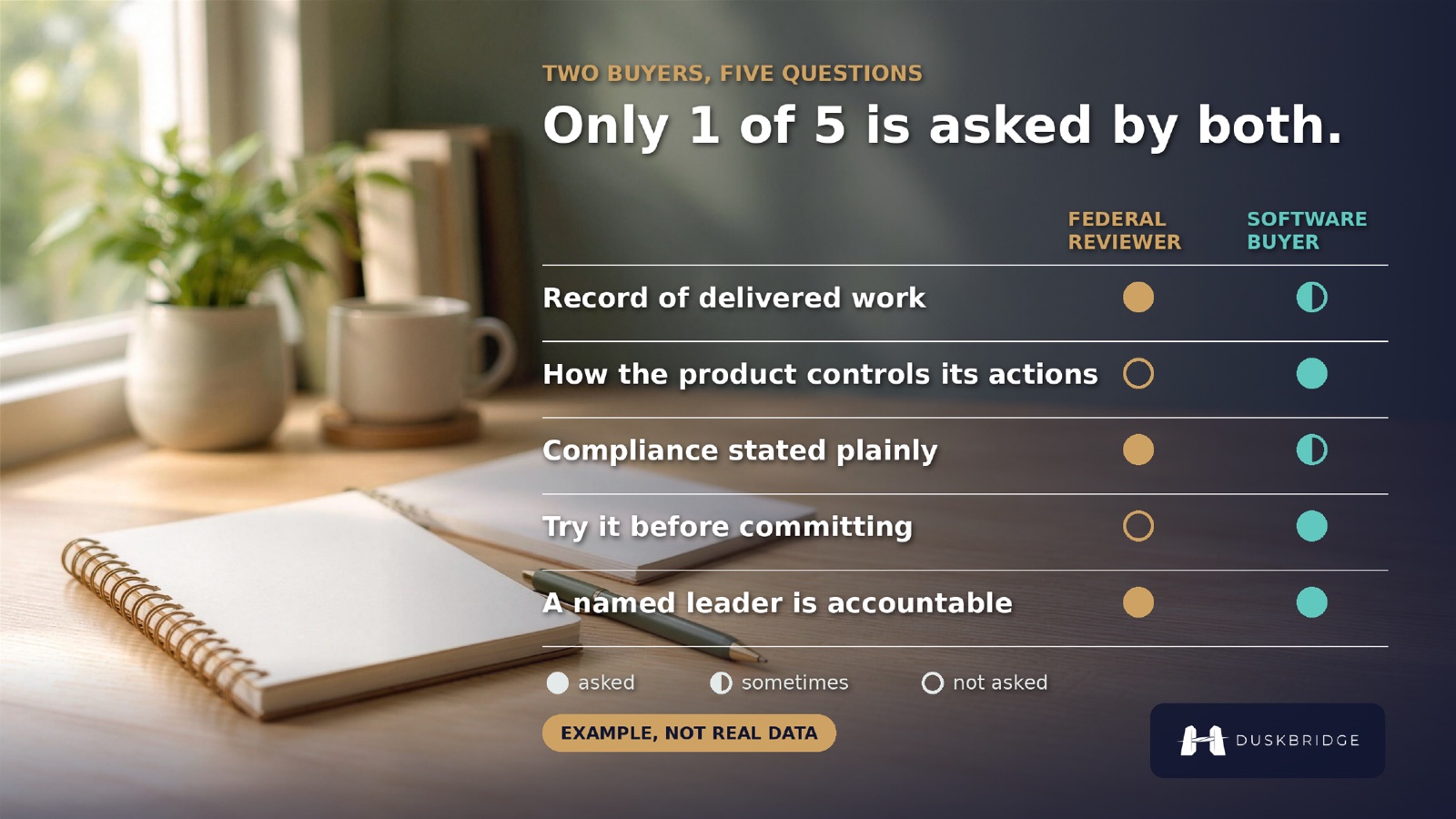
Of the five questions, one is asked by both buyers, two are asked only by the software buyer, and two are asked mainly by the federal reviewer. A single brand would have to answer all five in each conversation. Each buyer would hear answers to questions they did not ask and would have to dig for the answer they did.
Four tests before you split a brand
Run these on any two companies in a group. Each answer points one way.
- Is the buyer the same person? If the same person buys from both, one brand. If the buyers sit in different organizations with different rules, lean toward two.
- Is the proof the same? If one body of evidence persuades both buyers, one brand. If each buyer wants a different kind, lean toward two.
- Would one company’s problem change how the other is judged? If a failure in one would change the other’s sales, a shared name carries that risk. If buyers would not connect them, the risk is small.
- Can each brand pay for itself? Each brand needs its own site, its own voice, and its own content. If a company is too small to fund that, share a brand until it is not.
| Test | One brand | Separate brands |
|---|---|---|
| Buyer | The same person buys from both | Different buyers follow different rules |
| Proof | One body of evidence works for both | Each buyer wants different evidence |
| Spillover risk | Buyers would connect the two | Buyers would not connect them |
| Funding | Neither can fund its own brand | Each can fund its own brand |
If tests one and two both point to one buyer and one proof, merge the brands. That is the honest answer for those two companies, and it is cheaper.
The same four tests on two made-up groups
Worked example two, using made-up groups for illustration only and not Duskbridge data: Group A holds a staffing company and a payroll software company. A single HR director signs for both, the same reference customers persuade that director, a payroll error would change how the staffing company is judged, and the two companies employ eight people between them. Group B holds a federal services company and a commercial software company. Their buyers sit in different organizations, they need different proof, neither one’s problems reach the other’s sales, and each has the revenue to fund its own site and content.
| Test | Group A | Group B |
|---|---|---|
| Is the buyer the same person? | Yes | No |
| Is the proof the same? | Yes | No |
| Would one company's problem change how the other is judged? | Yes | No |
| Can each brand pay for itself? | No, eight people in total | Yes |
| Answer | One brand, four of four | Two brands, four of four |
Group A should merge its brands. Splitting would cost it extra hours every week that it cannot spare and would give its one buyer two names to check. Group B should keep two. The same test gives opposite answers because the buyers are different, which is why a blanket rule to keep brands separate, or to merge them, does not hold up.
What a separate brand costs
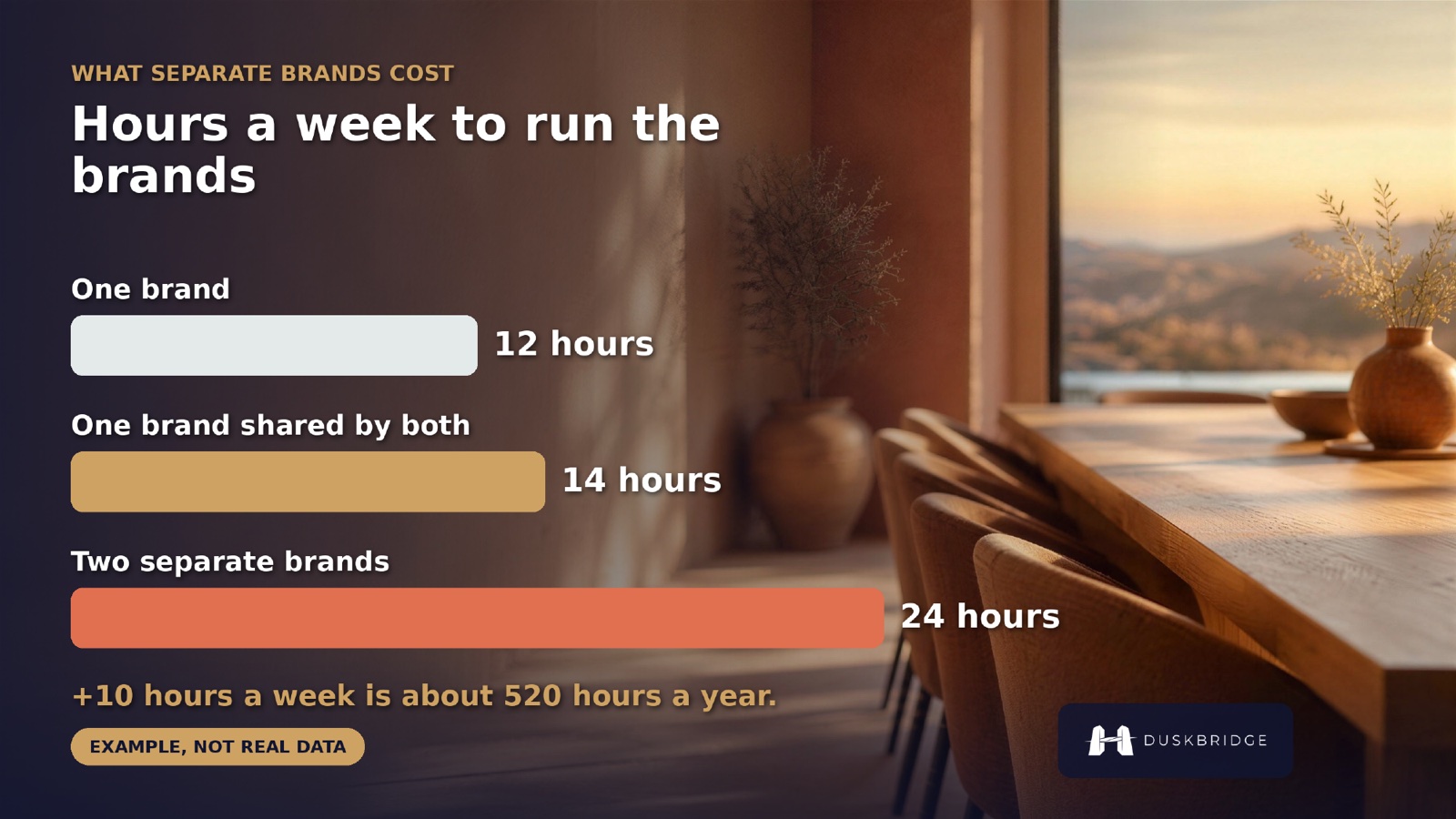
Separate brands are not free, and the research above is why we say so first. Each one needs its own website, voice, content plan, and review. Worked example, using made-up numbers for illustration only: suppose running one brand well takes 12 hours a week of writing, design, and review. Two brands take about 24 hours, and a shared brand run for both would take closer to 14 because some work is shared but a mixed message needs extra checking. The 10 extra hours a week, about 520 a year, is the price of keeping each promise clean. It is worth paying only when the buyers in the first test are different.
A real example: how Duskbridge splits it
Duskbridge’s site describes Viceroy NM as federal procurement and delivery and Trunnion AI as governed enterprise software. Duskbridge, Inc. is the parent holding company of both, and in an October 5, 2026 post we wrote that each company keeps three things of its own: its brand, its profit and loss, and its leadership.
That same post lists what the group sets for everyone: one job title ladder, one writing standard, and one board. The brands are separate and the frame around them is shared. In our view, that is the right split. Share what means the same thing everywhere, such as a title or a writing rule. Separate what a buyer judges, which is the promise. This post is about brands and not about legal structure, which the October 5 post covers.
The mistake and the fix
The mistake: merging brands because one name looks tidier on a chart. The chart gets simpler. The buyer gets a name that has to cover two promises, and a name that covers two promises is checked against both.
The fix: write one sentence per company in this form: “For [buyer], we promise [specific thing].” Keep each under 20 words. If the two sentences name different buyers and different promises, keep two brands. If they read the same, merge them.
A second mistake: separate names, one voice. A group can give each company a brand and still write for both in the same generic tone. The brand is then separate in name only. Cover the logo on three pages from each company and ask whether a buyer could tell which company wrote each one. If the answer is no for two or more, the voices have drifted together.
Where Duskbridge fits
Duskbridge is the parent holding company of Viceroy NM and Trunnion AI. Its role in the arrangement discussed here is narrow: hold the three things that are the same for everyone, a title ladder, a writing standard, and a board, as set out in the October 5, 2026 post, and keep out of the promise each company makes to its own buyers. A parent that put its name on every page would answer the question for the buyers. A parent that keeps the frame short lets each company answer for itself.
Run the test this week
- List the companies or product lines in your group.
- For each one, write the one buyer it most needs to convince.
- Write that buyer’s five deciding questions.
- Count how many questions two companies share.
- If four or five are shared, plan to merge the brands. If one or two are shared, keep them apart and write down the reason, with a date to review it.
Talk to us
If you are weighing whether your own group needs one brand or two, contact Duskbridge. If you are evaluating Duskbridge as a partner or a candidate, ask us two questions: what promise does each company discussed here make, and to whom?
This article is for general informational and educational purposes only. It is not legal, financial, medical, or other professional advice. Duskbridge makes no guarantee that it is accurate, complete, or current. Use of this information is at your own risk.
Details current as of November 1, 2026. Next review February 1, 2027. Group structure and product details can change, so confirm current terms with Duskbridge and Trunnion AI before relying on them.
Sources
Accessed October 28, 2026, and rechecked November 1, 2026. Duskbridge site pages last checked October 21, 2026.
- David A. Aaker and Erich Joachimsthaler, The Brand Relationship Spectrum: The Key to the Brand Architecture Challenge, California Management Review, vol. 42, no. 4, pp. 8-23 (Summer 2000).
- David A. Aaker and Erich Joachimsthaler, Brand Leadership, The Free Press (2000). The article above is adapted from this book.
- Vithala R. Rao, Manoj K. Agarwal, and Denise Dahlhoff, How Is Manifest Branding Strategy Related to the Intangible Value of a Corporation?, Journal of Marketing, vol. 68, no. 4, pp. 126-141 (2004).
- Vithala R. Rao, Manoj K. Agarwal, and Denise Dahlhoff, Branding Strategy and the Intangible Value of the Firm, Marketing Science Institute Working Paper 03-126 (2003).
- Duskbridge, What a parent company does for its companies, and what it leaves to them (October 5, 2026).
- Duskbridge companies.
This article may discuss strategy, possible capabilities, acquisitions, investments, or market development. Those statements are forward-looking, uncertain, and not commitments or guarantees; see Terms section 6.
Continue the conversation